Three-Dimensional Spatial and Translational profiling of Stress Response Pathways in T1D
Contact PI: Farooq Syed, PhD, City of Hope (R03 DK147504)
Start Date: May 1, 2026
NIH HIRN Gateway Investigator Award Recipient
Abstract
Type 1 diabetes (T1D) results from autoimmune destruction of the pancreatic β cells, leading to
insulin deficiency and chronic hyperglycemia. Accumulating evidence suggests that β cell stress
during disease progression may play an active role in amplifying this autoimmune response
through the generation of non-canonical or immunogenic proteins. We and others have shown
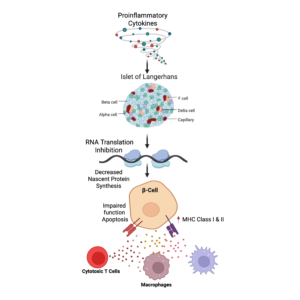
that proinflammatory cytokines (IFN-α and IFNg + IL-1b) activate downstream signaling pathways
within the β cell and create a feedforward cycle of inflammation and endoplasmic reticulum (ER)
stress. Moreover, a growing body of evidence indicates that chronic ER and oxidative stress lead
to the activation of the integrated stress response (ISR), a cytoprotective mechanism that
maintains cellular protein homeostasis in response to environmental and cellular stress signals.
However, chronic activation of ISR may lead to dysregulation in global RNA translation and the
generation of immunogenic peptides, particularly neoantigens. These, when presented within the
HLA complex, can initiate autoimmunity against β cells in early T1D. Our long-term goal is to
identify how distinct cytokine signatures impact or influence b cell stress pathways during different
stages of T1D progression. Thus, we hypothesize that proinflammatory cytokine-mediated
activation of ISR in early T1D amplifies β-cell dysfunction and immunogenicity via changes in
RNA translation and increased neoantigen production and presentation. We aim to test this
hypothesis by: 1) defining how proinflammatory cytokines individually and in combination
selectively modulate β cell mRNA translation and production of known neoantigens and map noncanonical
RNA translation (ncORF) or untranslated open reading frames (uORF) or frameshift
translation to the non-canonical proteins that are actively translated during inflammatory stress in
human islets and 2) 3D spatial evaluation of disease specific RNA and protein translation in intact
pancreatic tissue sections of autoantibody positive (AAb+), type 1 diabetes (<1 year of duration)
and age, BMI and sex-matched non-diabetic control organ donors. This research is innovative
because it employs innovative multi-omics approaches to map the distinct and global effects of
selected cytokines and temporally monitor their impact on islet cell RNA translation with high
precision. The proposed work will significantly advance our understanding of how β cells are
altered in their function, stress pathways and antigenic profile during the early stages of T1D.
Results from these studies have the potential to inform the development of biomarkers and
therapies aimed at preventing T1D and protecting the functional β cell mass.
 Follow


