Investigating the Role of RNA Editing in T1D in Humans
Contact PI: Qin Li, PhD, University of Pennsylvania (R03 DK147541)
Start Date: May 1, 2026
NIH HIRN Gateway Investigator Award Recipient
Abstract
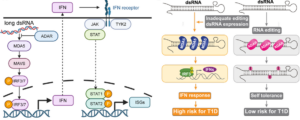
The staging model for human type 1 diabetes (T1D), proposed by Eisenbarth nearly 40 years ago, and reaffirmed recently, posits that disease progression for individuals with genetic susceptibility depends on a triggering event. The nature of this triggering event remains a crucial open question in T1D. Evidence shows an IFN response in pancreatic islets during early T1D stages, potentially triggered by viral infections. However, recent studies have not found definitive proof of a viral cause. Instead, the IFN response could also originate from non-viral sources. MDA5, a cytosolic dsRNA sensor, triggers an IFN response when detecting virus-like long dsRNA. Human genetic evidence shows that Gain-of-Function (GoF) mutations of MDA5 cause enhanced IFN activation, while Loss-of-Function (LoF) mutations protect against multiple autoimmune diseases, including T1D. ADAR1, an enzyme expressed in virtually every cell in our body, edits endogenous dsRNAs by converting adenosine to inosine to prevent MDA5 activation on “self” dsRNAs. Mutations in ADAR1 cause severe autoinflammatory diseases, suggesting its importance in regulating immune response. Study showed that loss of ADAR1 in mouse β cells triggers a significant IFN response, leading to inflammation and β cell destruction, mimicking early-stage T1D in. Our recent work, based on human genetic data, made a remarkable discovery of the role of RNA editing in T1D. We demonstrated that insufficient RNA editing caused by risk variants of T1D is linked to elevated IFN immune response observed in pancreas and immune cells of T1D patients. Together, human and mouse genetic data strongly suggest poorly edited endogenous dsRNAs as a trigger of T1D. Using human genetics, genomics, and molecular biology approaches, we propose to investigate the functional connection between RNA editing and T1D in humans. First, we will investigate RNA editing in T1D and non-T1D islet in a cell-type-specific manner. Second, we aim to determine the key islet cell types whose inadequate RNA editing triggers MDA5-dependet IFN response. Taken together, our proposed studies will identify a new pathway underlying T1D and novel therapeutic targets for delaying T1D onset.
 Follow


