Discovery of Pathways and Molecular Mediators of Early T1D Pathogenesis using Spatial Multi-Omics
Contact PI: Wei-Jun Qian, PhD, Battelle Pacific Northwest National Laboratory (U01 DK143488)
Rohit Kulkarni, PhD, MPI, Joslin Diabetes Center
Martha Campbell-Thompson, PhD, MPI, University of Florida
Clayton Mathews, PhD, Co-Investigator, University of Florida
Geremy Clair, PhD, Co-Investigator, Battelle Pacific Northwest National Laboratory
Start Date: May 5, 2026
Abstract
Type 1
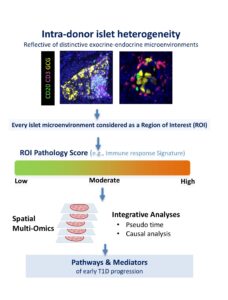
diabetes (T1D) is a complex autoimmune disease characterized by a prolonged, progressive decline in pancreatic beta-cell function prior to clinical onset. Currently, a significant gap remains in our understanding of the precise molecular mechanisms driving this early pathogenesis. The long-term goal of this project is to delineate the in situ molecular mechanisms of early human T1D development through advanced spatial multi-omics profiling of human islet microenvironments within pancreas. Our central hypothesis is that critical pathways and molecular mediators of disease progression can be uncovered by analyzing individual islet microenvironments through the lens of intra-donor heterogeneity using spatial multi-omics. By capturing the variations within each presymptomatic or new-onset donor, spatial omics data will allow us to reconstruct a “pseudo-time” progression of islet dysfunction. We will address the following specific Aims: Aim 1) Identify pathways and mediators of early pathogenesis through spatial multi-omics profiling of intra-donor heterogeneity across individual islet microenvironments in presymptomatic multiple AAb+ and new-onset T1D cases. Aim 2): Characterize islet microenvironments at single-cell resolution to reveal localized cellular niches and molecular features associated with distinct forms of islet dysfunction, such as insulitis or beta-cell loss. Aim 3): Explore the functional significance of identified molecular mediators, assessing their roles in cellular communication and beta-cell survival using human islet/beta-cell and acinar cell co-cultures. Our approach is uniquely enabled by an innovative suite of mass spectrometry-based spatial proteomics, spatial transcriptomics, and mass spectrometry imaging (MSI) for lipidomics and extracellular matrix (ECM)-omics. This project will establish unique spatial omics datasets on human islet microenvironments during the early stages of T1D, providing novel resources to be shared with the larger scientific community.
 Follow


