Targeting Renalase for Early Stage Type 1 Diabetes Treatment
Contact PI: Peng Yi, PhD, Joslin Diabetes Center (U01 DK143496)
Nese Kurt Yilmaz, PhD, MPI, UMass Chan Medical School
Accalia Fu, PhD, MPI, UMass Chan Medical School
Ali Akhbar, PhD, Co-Investigator, UMass Chan Medical School
Celia A Schiffer, PhD, Co-Investigator, UMass Chan Medical School
Start Date: April 10, 2026
Abstract
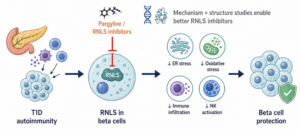
Type 1 diabetes (T1D) is an autoimmune disease that destroys insulin-producing beta cells in the pancreas, requiring insulin injections and blood glucose monitoring, which do not replicate the precise glycemic control of functional beta cells nor prevent disease progression and complications. In long-standing T1D, most beta cells are destroyed, which requires the replenishment of beta cell mass to restore insulin production. This can be achieved by regenerating endogenous beta cells or differentiating human embryonic stem cells (ESCs) or induced pluripotent stem cells (iPSCs) into beta cells for transplantation, combined with therapies to prevent autoimmune destruction of the newly formed beta cells. Different therapeutic windows exist for intervention or a potential cure, particularly in early-onset or newly diagnosed T1D where significant beta cells remain, presenting an opportunity to intervene and preserve these cells, potentially delaying or preventing further beta cell loss. Recent findings suggest that beta cell injury or stress may significantly contribute to immune-mediated beta cell loss in T1D, thus therapies aimed at reducing beta cell stress and injury may avert immune targeting during the progression to overt T1D. Combining beta cell therapies with immune modulation may yield better outcomes, yet the specific targets and pathways for effective treatment remain unclear. Renalase (RNLS) has emerged as a promising therapeutic target in T1D, being associated with T1D in genome-wide association studies (GWAS) and linked to beta cell protection. Loss of RNLS function in beta cells reduces endoplasmic reticulum (ER) and oxidative stress, immune cell infiltration, and natural killer (NK) cell activation, preventing autoimmune destruction. Designing a better strategy for targeting RNLS enzymatic activity may offer a potential therapeutic strategy for T1D by providing beta cell protection against stress and autoimmunity in humans. RNLS, known as an oxidase similar to monoamine oxidases (MAO), can be bound by some MAO inhibitors. We found that one of the FDA approved MAO inhibitors, pargyline, is able to bind to RNLS and protect pancreatic beta cells from stress and autoimmune destruction. Apparently, pargyline may not be specific or potent enough for RNLS. Therefore, developing a more specific and potent RNLS inhibitor is crucial. Utilizing structure-based drug design, the goal is to create a new class of compounds for early or preventive treatment of T1D. This research includes uncovering RNLS’s role in beta cell metabolism and immune interactions, characterizing RNLS structure and enzymatic function for robust assay development, and evaluating RNLS inhibitors by biochemical, cell, and animal model-based assays. The expected outcome is the development of potent and selective RNLS inhibitors that enhance beta cell survival and function, reduce stress and autoimmune destruction, and demonstrate safety and efficacy in humanized mouse models, providing promising therapeutic options for T1D by protecting beta cells from stress and immune attacks at an early stage.
 Follow


