Interrogating the Role of Environmental and Cellular Factors in Human T1D Pathophysiology using a Physiological, Isogenic 3D Platform
Contact PI: Cherie Stabler, PhD, University of Florida (R56 DK144181)
Holger Russ, PhD, Co-Investigator, University of Florida
Start Date: August 1, 2026
Abstract
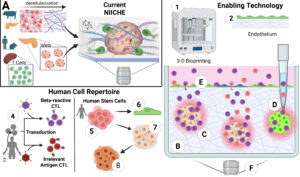
Creating better therapies to prevent or inhibit deleterious immunological responses, such as in autoimmunity, is hindered by our incomplete understanding of their pathogenesis. For example, no therapeutic approach is currently capable of curing or providing durable prevention f rom autoimmune type 1 diabetes (T1D). This lack of progress largely stems f rom an incomplete understanding of the interactions among key human cellular players involved in human T1D, and of how these interactions and the environment contribute to disease-causing ef fects. Current tools, f rom animal models to basic culture dishes, are limited in providing this insight. We developed a novel alternative method (NAM) to address these limitations, by creating a three-dimensional (3D) extracellular matrix-based pancreatic tissue mimic, termed the Native Islet-Immune Cell Hydrogel Environment (NIICHE). This NIICHE platform delivers new insights into human immunological processes associated with T1D by collecting 3-D, real-time, noninvasive measurements of immune cell recruitment and engagement with targeted beta cells. With the NIICHE established as a robust, human-centric benchtop screening platform, this proposal seeks to expand its utility and capacity for further testing of the human T1D hypothesis and therapeutics. Specif ically, this R56 proposal seeks to establish the following key engineering and cellular goals. Aim 1) Integrate 3D printing methods for the addition/retrieval of cells and materials to impart spatial control and retrieval. Aim 2) Establish a protocol for the stable integration of sEC monolayer atop the NIICHE and validate visualization of extravasation through the endothelium in response to a chemokine gradient. Aim 3) Expand to additional T cell sources for use in the NIICHE platform and evaluation of the dif ferential immunogenicity of human beta cell subpopulations. Achievement of these goals will create a NAM that supports the distinct placement and retrieval of cells within the 3D matrix, as well as the capacity to distinctly interrogate the role of the endothelial barrier in immune cell recruitment. Finally, expanding our cellular repertoire to include additional T cell and beta cell sources will enhance the utility and predictive capacity of this benchtop system. Once established, this expanded platform can deliver unique insights into pathogenesis and serve as a screening tool for new therapeutic targets. Beyond the T1D focus proposed herein, we envision that this practical and highly translatable 3D platform has broad utility, as its capacity to quantitatively track and assess 3D cellular interactions, traf f icking, extravasation, and immune cell attack enables investigation of numerous immunocentric questions.
 Follow


