Isogenic Modeling of Immune-Beta Cell Interactions, Alterations in Beta Cell Phenotype, and Vulnerability to Cytotoxic Killing
Contact PI: Eddie James, PhD, Benaroya Research Institute (R56 DK147805)
Adam Lacy-Hulbert, PhD, Co-Investigator, Benaroya Research Institute
Jia Zhu, PhD, Co-Investigator, University of Washington
Start Date: July 1, 2026
Abstract
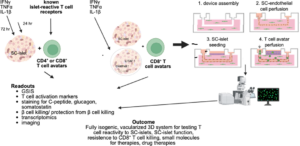
Because it is unsafe to access human pancreatic islets from living donors, surrogate experimental systems are needed to answer important questions about the mechanisms through which insulin-producing β cells are destroyed in individuals who develop type 1 diabetes (T1D). Protocols for differentiating induced pluripotent stem cells (iPSCs) into islet-like clusters (SC-islets) provide a replenishable source of beta cells and are a promising alternative means for modelling interactions between human islet endocrine cells and immune cells. However, currently available biomimetic systems are not able to maintain the long-term viability of SC-islets and are not isogenic and therefore, unable to accurately model autoimmune interactions. To meet this need, this project will develop a vascularized 3D biomimetic microphysiological system (MPS) that will allow fully isogenic modelling of interactions between islets and immune cells in prolonged culture. Our basis for this model system is a proven perfusion-capable microfluidic skin-on-chip platform. This plexiglass-based chamber system has an open well on the top, which is readily adaptable to create an ideal system for culturing SC-islets. A microchannel network within the chamber promotes the formation of a vascular network in a supporting matrix. The system has been designed with inlet and outlet ports for perfusing endothelial cells, medium, cytokines, or immune cells. Furthermore, the system is configured to allow live imaging and removal of SC-islets and immune cells from the system for downstream analysis. We predict that this approach will overcome some of the described limitations of existing SC-islet culture systems and will allow mechanistic interrogation of mechanisms that promote sustained autoimmunity and pathologic interactions between SC-islets and autoreactive T cells. We will fully implement this system and demonstrate its suitability for studying interactions between human SC-islets and autoreactive T lymphocytes and then utilize it to ask specific questions about the effects of inflammatory stress on SC-islet phenotype. Importantly, our experiments will utilize T cell lines and T cell receptor sequences obtained from pancreatic organ donors with T1D, as these represent the most relevant T cells for mechanistic studies. Specifically, we will investigate the effects of inflammatory stress on islet phenotype, function and interactions with autoreactive T cells, first using 3D cultures (suitable for modeling short-term inflammatory stress) and then in the islet-on-chip system (suitable for short and long-term inflammatory stress). This will enable us to test the hypothesis that inflammatory stress alters beta cell phenotype and drives increased immune perception during the development of T1D. In addition, we will utilize the islet-on-chip system to investigate the role that the membrane repair pathway plays in dictating the vulnerability of beta cells to immune attack. We anticipate that modeling interactions between SC-islets and cytotoxic T cells will reveal a crucial role of the membrane repair pathway in determining vulnerability to immune attack. These insights are likely to suggest novel pathways that can be leveraged to treat T1D.
 Follow


